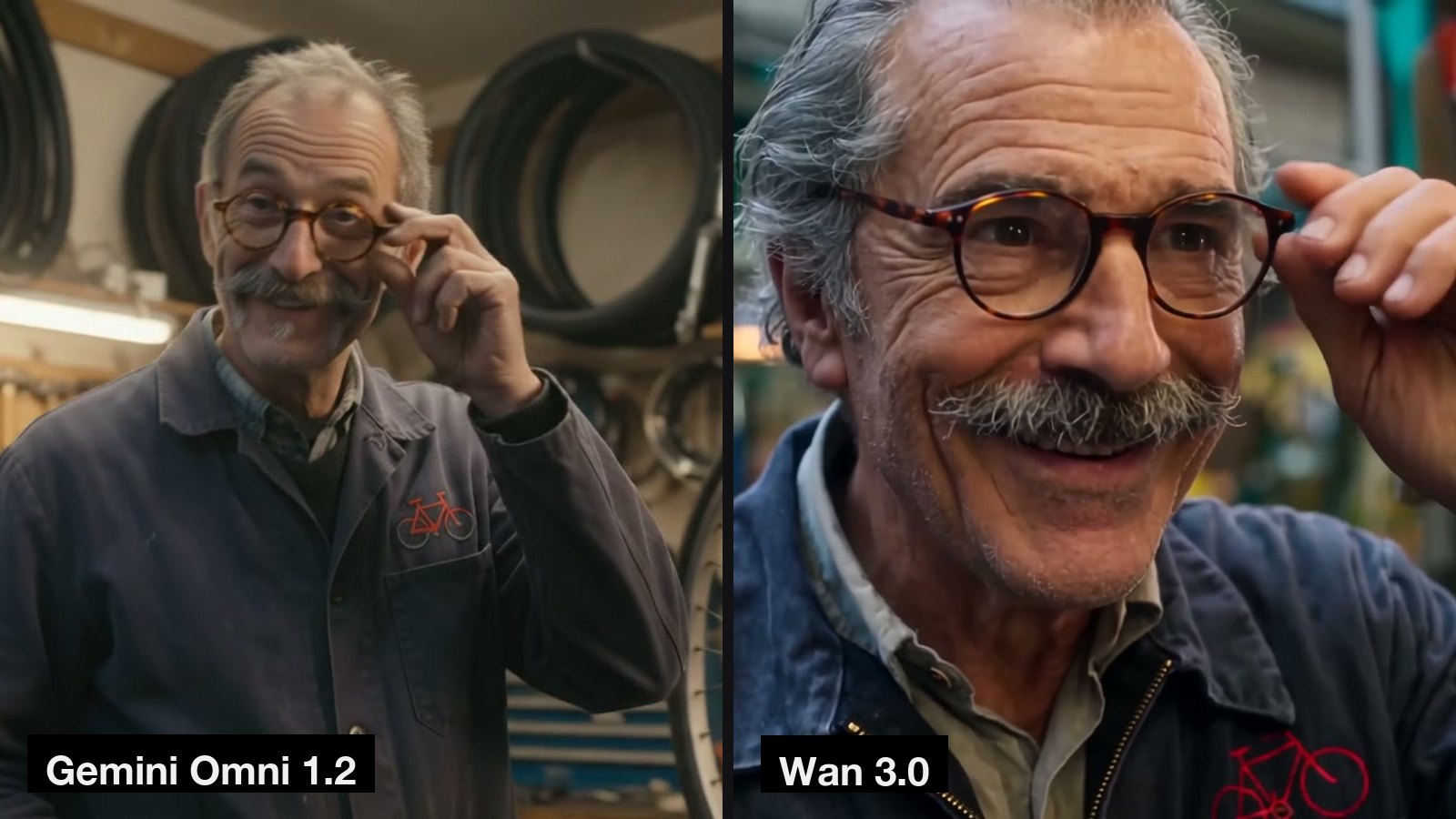
Most AI video model comparisons show a few hand-picked clips. We wanted to know which model gets a hard, specific brief right more often. So we wrote one scene, gave it to Gemini Omni 1.2 and Wan 3.0 in exactly the same way, and had every result ranked blind.
The short version
Pick Gemini Omni 1.2 to follow a script closely for less. Pick Wan 3.0 to keep the location consistent from shot to shot.
- Following the brief: Omni 1.2 hit more of the specified shots, gestures and props. Its two text-only takes ranked first and second in all three blind rounds. With reference images, the models were close.
- Continuity: the AI judge didn't really score whether the set stays the same when the camera moves. Watching all eight clips ourselves, we found Wan 3.0 clearly better at it.
- Cost: Omni 1.2 is about 27% cheaper.
- Takes: make at least two with either model. With references, the gap between Wan 3.0's two takes was bigger than the gap between the models.
This is one scene, one AI judge and our own review, so treat it as a strong tendency, not a final ranking.
The test
The scene is a 15-second, five-shot story set in a covered market in Marseille at dusk. A courier cycles in through puddles, an old bike mechanic fixes her chain, and they share a sparkling water as the rain starts again. Each shot has a timecode, specific actions, a branded prop and sound cues:
Shot 1 (0-3 s):  Wide, low angle. Maya rides her bike into the market,
                 splashing through puddles under the string lights.
Shot 2 (3-6 s):  Medium tracking shot. She skids to a stop in front of
                 the bike shop; her chain hangs loose.
Shot 3 (6-9 s):  Close-up. Theo looks up from a wheel, pushes up his
                 glasses and smiles under his moustache.
Shot 4 (9-12 s): Over-the-shoulder. Theo clicks the chain back on while
                 Maya sets two LUMA cans on the workbench and slides
                 one to him.
Shot 5 (12-15 s): Wide, slow push-in. They clink cans and laugh as light
                 rain starts again behind them.
Sound: soft accordion and guitar, rain on the glass roof, a freewheel
ticking, the hiss of a can opening. No dialogue.
The full prompt also describes both characters (Maya's short curly hair, shaved on one side, and mustard-yellow jacket; Theo's grey moustache and round tortoiseshell glasses), the location and the can. Maya, Theo and LUMA are invented for this test.
We ran the scene two ways: text only, and with 4 references (the same script plus images of the courier, the mechanic, the location and the product).
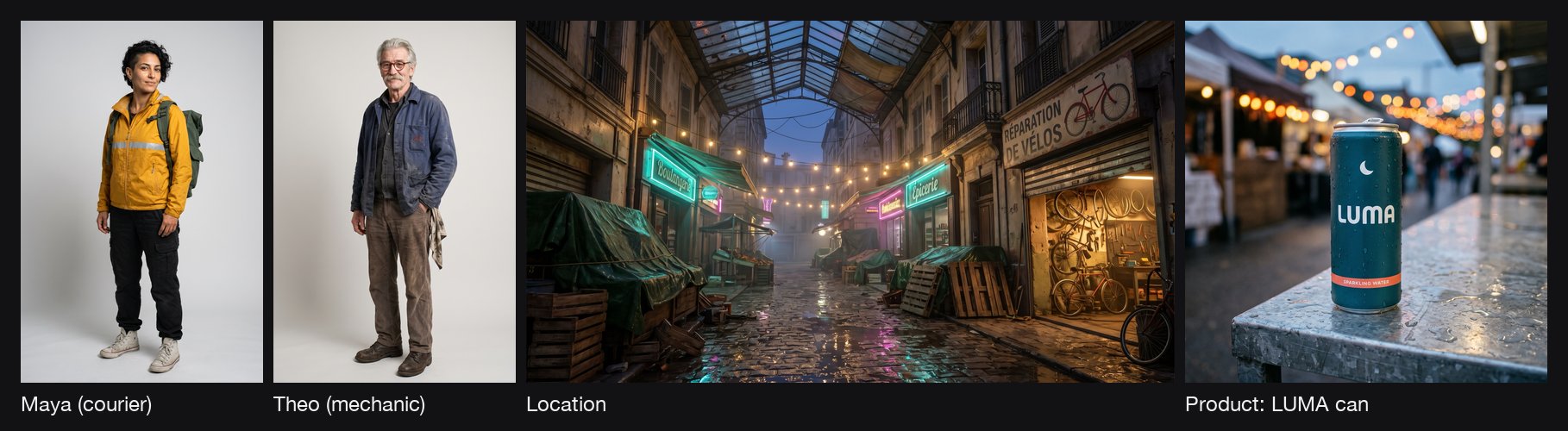
Each model rendered two takes per setup at 720p, 16:9, 15 seconds, with audio. That is eight clips in all.
How we judged
Every clip was judged twice: once by a blind AI judge, and once by us.
The AI judge. A multimodal AI model watched every clip with the labels hidden, scored each one from 1 to 10 on seven criteria (plus reference likeness in the reference test), and ranked them. We ran this three times, reshuffling the clip order each time. The judge was a Gemini model, and Omni 1.2 is also from Google, so self-preference is a fair concern. But in the reference test it ranked a Wan 3.0 clip first in two of the three rounds, which argues against a strong bias. A mild one can't be ruled out, so treat close results as close.
Our own review. We also watched all eight clips ourselves, looking for what a scorecard can miss. The biggest difference we found was continuity: whether the location stays the same place from shot to shot (see below).
Results: text only
| Clip | Average rank (1 = best, of 4) |
|---|---|
| Gemini Omni 1.2, take 1 | 1.0 |
| Gemini Omni 1.2, take 2 | 2.0 |
| Wan 3.0, take 1 | 3.3 |
| Wan 3.0, take 2 | 3.7 |
Omni 1.2 came first in all three rounds and scored higher on every criterion except lighting and mood, where the two tied:
| Criterion (average score /10) | Gemini Omni 1.2 | Wan 3.0 |
|---|---|---|
| Prompt adherence | 6.5 | 5.3 |
| Shot structure | 6.8 | 5.7 |
| On-screen text | 6.5 | 5.5 |
| Visual quality | 6.5 | 5.7 |
| Consistency over time | 6.0 | 4.8 |
| Lighting and mood | 6.3 | 6.3 |
| Audio | 6.5 | 5.7 |
The contact sheet shows one frame from the middle of each shot, for every take.
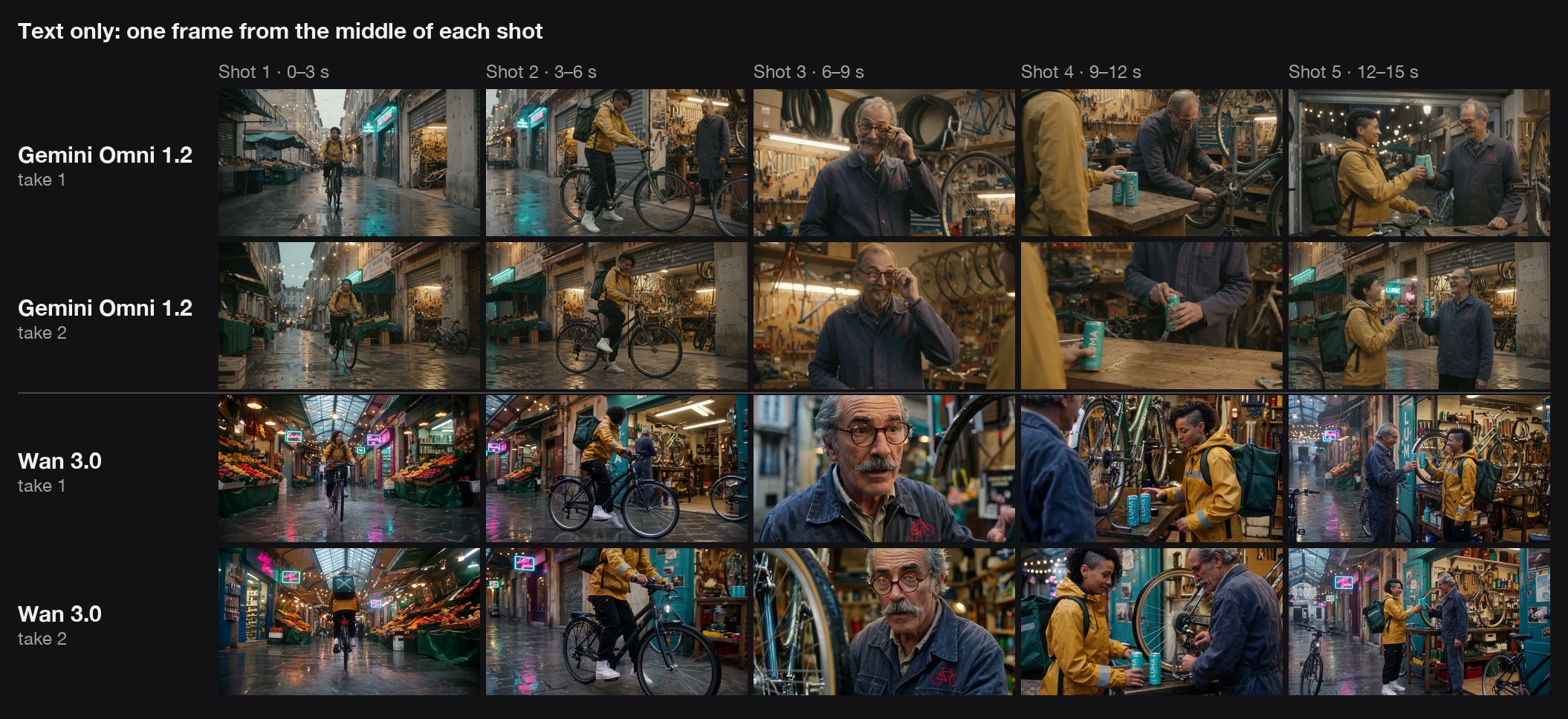
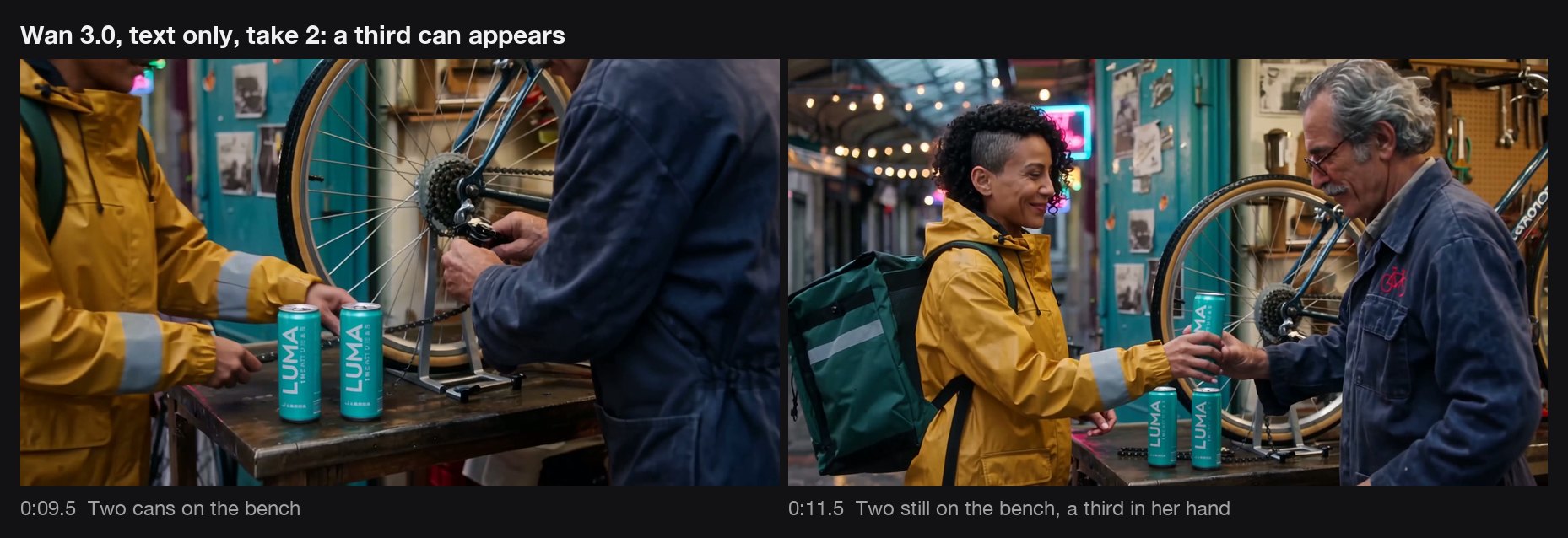
Wan 3.0 ran shots 1 and 2 together as one continuous shot in both takes, instead of cutting between them. In take 2, a third can appears in the courier's hand while both original cans are still on the bench. And the script's working title, "Last Delivery", leaked onto the set: shop signs behind the courier read "LAST DEL…".
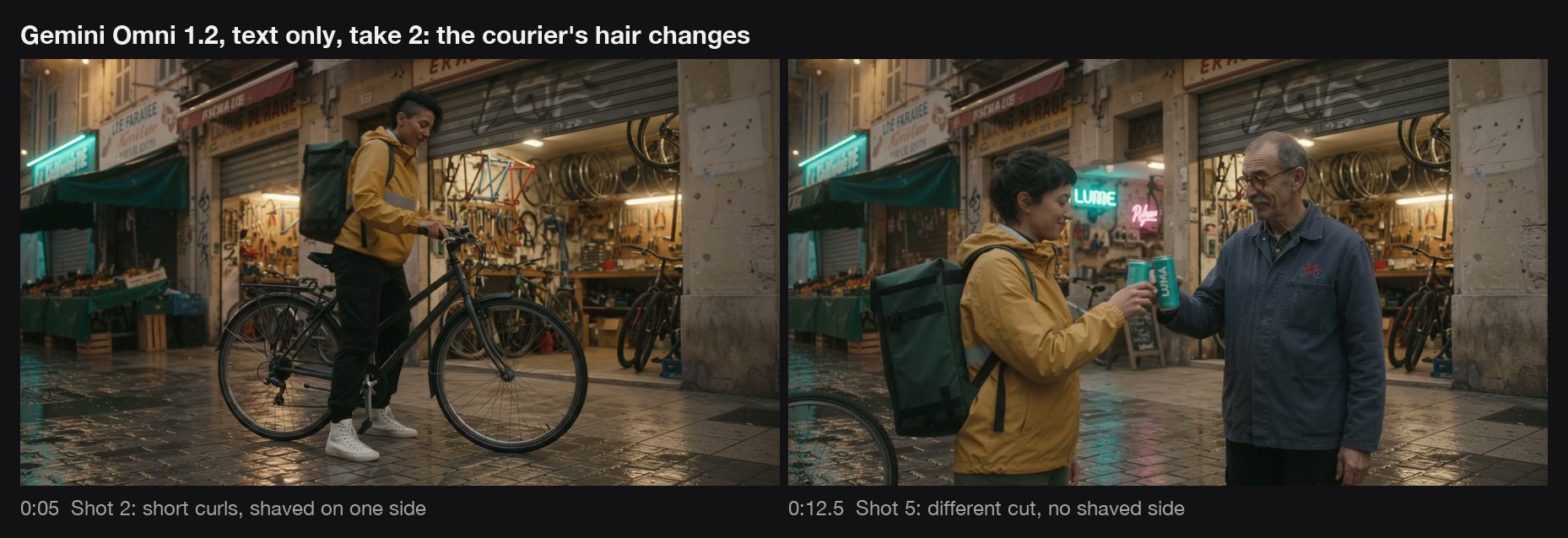
Gemini Omni 1.2's take 1 played all five shots as written, with the glasses gesture on cue and a clear hiss as the can opens. Take 2 kept the structure but changed the courier's haircut in the last shot.
Results: with 4 reference images
| Clip | Average rank (1 = best, of 4) |
|---|---|
| Wan 3.0, take 2 | 1.7 |
| Gemini Omni 1.2, take 2 | 2.0 |
| Gemini Omni 1.2, take 1 | 2.3 |
| Wan 3.0, take 1 | 4.0 |
With references the gap closes. Wan 3.0's better take ranked first in two of the three rounds; its other take came last every time. Outside shot structure, the two models scored within 0.3 points of each other on every criterion.
| Criterion (average score /10) | Gemini Omni 1.2 | Wan 3.0 |
|---|---|---|
| Reference likeness | 6.8 | 6.7 |
| Shot structure | 6.5 | 4.8 |
| Prompt adherence | 6.0 | 5.7 |
| Lighting and mood | 6.8 | 7.0 |
| Visual quality | 6.3 | 6.3 |
| On-screen text | 6.3 | 6.2 |
| Consistency over time | 5.7 | 5.7 |
| Audio | 6.2 | 6.2 |
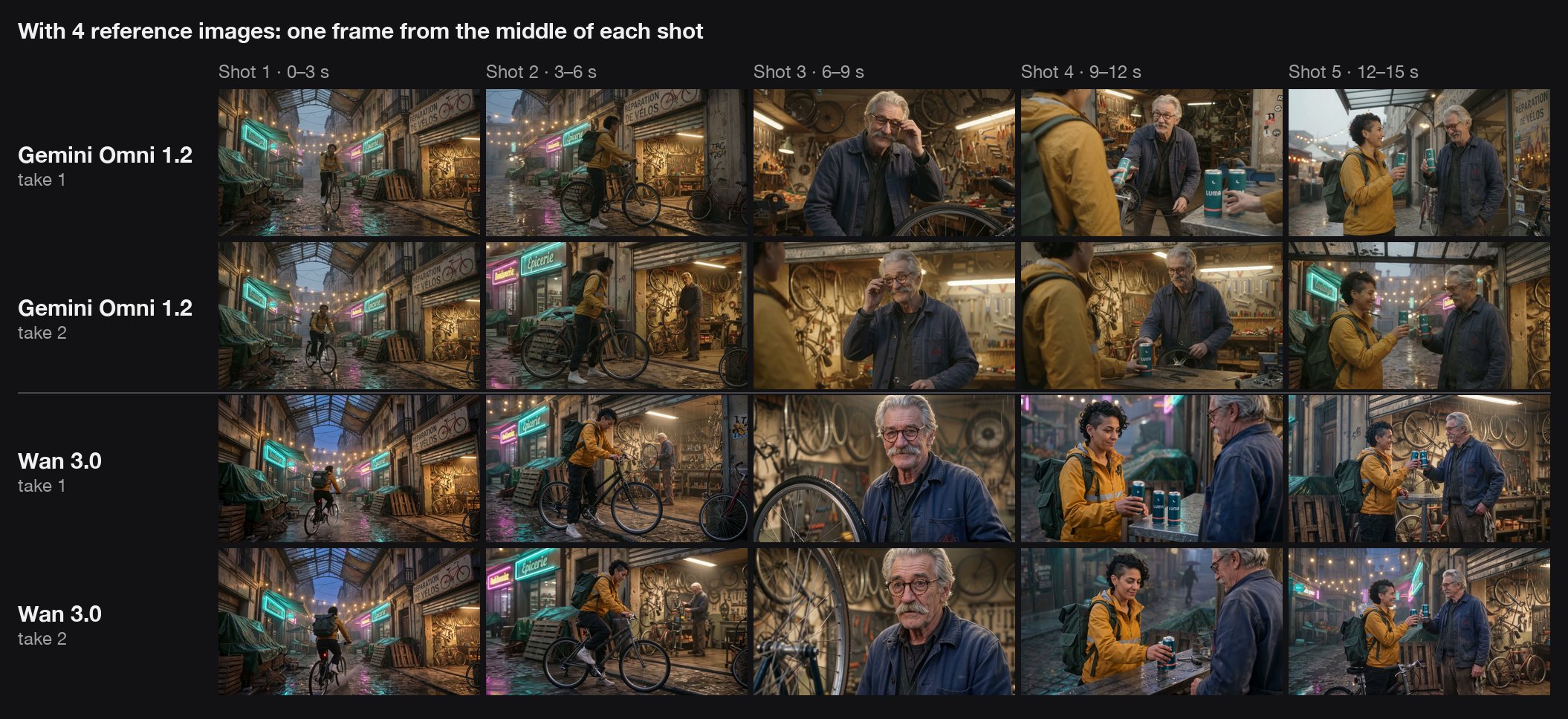
Both models kept the characters recognisable and matched the reference location closely. Omni 1.2 was steadier on structure: both Wan 3.0 takes opened with the courier riding away from the camera rather than towards it, and the weaker one added a sixth shot. Neither model handled the cans cleanly in shot 4, with an extra can or only one set down in takes from both.
What the AI judge missed: continuity
The judge mainly scored how well each clip followed the brief. Watching the clips ourselves, something else stood out: whether the place stayed the same place when the camera moved.
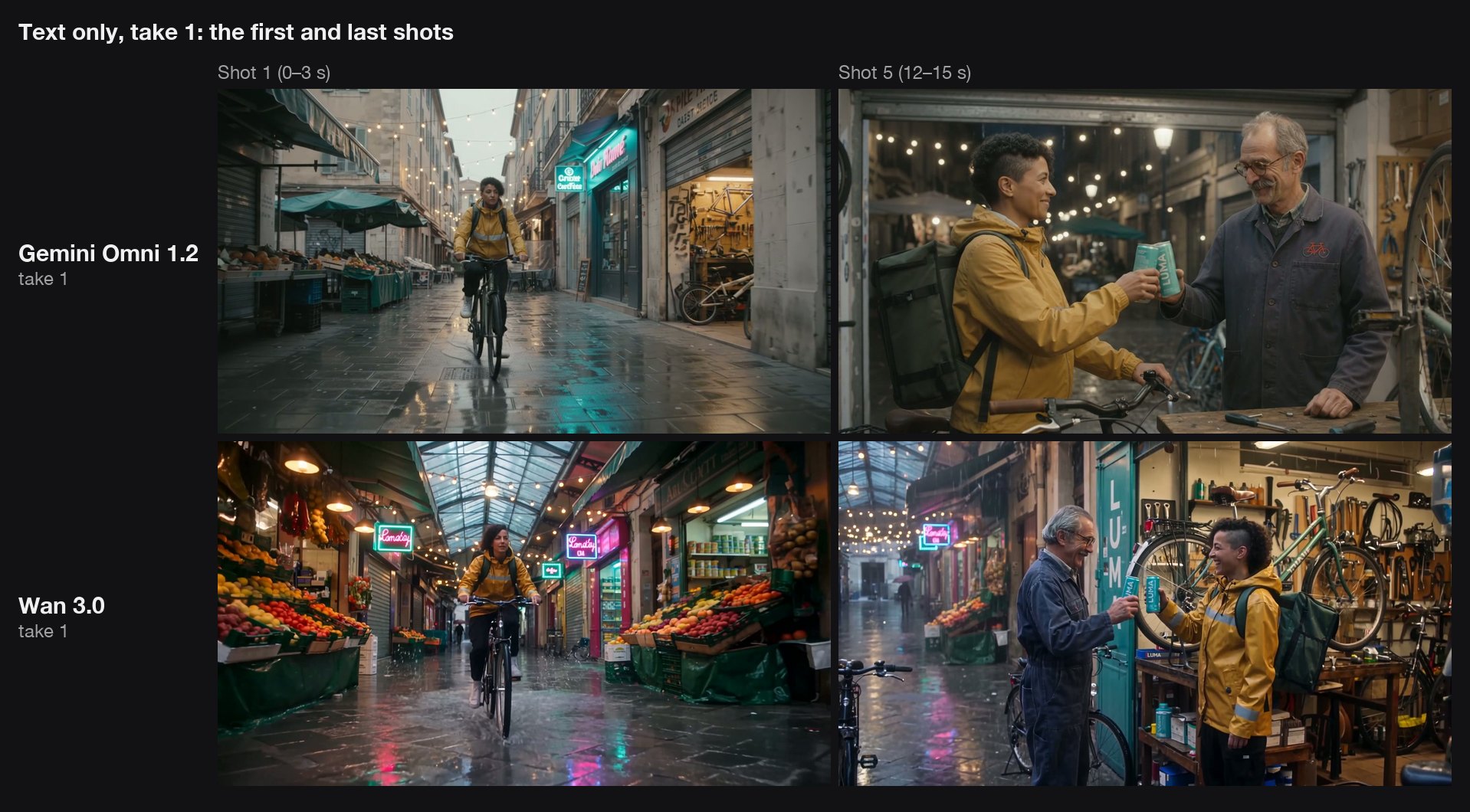
Wan 3.0 kept the environment consistent. In both text-only takes, the market's glass roof is there in the opening wide shot and again at the end. In take 1, the pink neon sign and fruit stalls from shot 1 are still in the background of shot 5. In take 2, the same teal shopfront runs through shots 2, 4 and 5.
Gemini Omni 1.2 rebuilt the set from angle to angle. Neither text-only take ever shows the glass roof, so the covered market becomes an open street. In take 2, two neon signs, one misspelling the brand as "LUME", appear inside the shop in the last shot. Shot 2 looks into the same shop from almost the same spot, and neither sign is there.
Wan 3.0's stray props, like that extra can, were less noticeable than Omni 1.2 reshaping the world around the characters.
The judge did score "consistency over time" and gave Omni 1.2 the higher mark (6.0 against 4.8), but it was tracking people and props, such as the courier's hair and Wan 3.0's extra can. It noticed the missing roof only as a missed detail of the brief.
Can you fix this in Omni 1.2? Probably, to a degree: with a location reference image, the gap between the models was smaller. For multi-shot scenes in Omni 1.2, name the fixed features of the location in every shot (for example "the same covered market with a glass roof, the teal shopfront on the left"), add a location reference, and use the Refine button in LeCinema to expand a short prompt before you generate. We haven't tested this yet and plan to in a follow-up.
Cost and reliability
LeCinema credits cost $0.01 each at list price. At 720p:
| Gemini Omni 1.2 | Wan 3.0 | |
|---|---|---|
| Per second | 11 credits | 15 credits |
| One 15-second clip | 165 credits ($1.65) | 225 credits ($2.25) |
| Two takes | 330 credits ($3.30) | 450 credits ($4.50) |
Rates are correct at the time of writing, and the app shows the exact cost before you generate.
Omni 1.2's safety filter refused 3 of our 37 requests, and Wan 3.0's output moderation rejected one reference-image render. Every refusal went through on an unchanged retry, so if a harmless prompt is refused, retry once before you rewrite anything.
Which should you use?
- Multi-shot scenes where continuity matters: Wan 3.0.
- Tightly scripted action and props on a budget: Gemini Omni 1.2.
- Strong reference images: either, but Wan 3.0's takes varied more.
- Longer than 15 seconds: Wan 3.0, which makes clips up to 30 seconds. Omni 1.2 stops at 15.
Try it on your own scene
Gemini Omni 1.2 is available to every LeCinema studio. Wan 3.0 is being turned on studio by studio, so it may not be in yours yet. Write a short multi-shot brief, run two takes on each model you have, and compare them side by side. We'll add more scenes to this test over time.